Most business owners think about a retirement plan as a benefit — something you offer employees to stay competitive, or something you'll "get around to" once the business is more stable.
I'd suggest a different frame. A qualified retirement plan is one of the very few tools the tax code gives you to legally redirect money that would otherwise go to the IRS into assets that you own.
Whether you run a company with twenty employees or you're a consultant working on your own, the tax savings show up in several distinct layers.
Understanding each layer is what separates owners who simply "have a 401(k)" from owners who use one strategically.
The Four Layers of Tax Savings
When we model retirement plans for clients, we look at four separate sources of value:
- A deduction today. Contributions reduce taxable income in the year you make them.
- Tax-deferred growth. Investment returns compound without an annual tax drag.
- Tax-free income later. Roth features let you build a bucket of money that may never be taxed again.
- Tax credits for the business. Smaller employers can have much of the cost of starting a plan subsidized by federal credits.
Let's walk through each one.
Layer 1: The Deduction Today
Employer contributions
When your business contributes to a qualified plan — a match, a profit-sharing contribution, or a safe harbor contribution — that money is generally deductible to the business.
Just as important, employer contributions are not subject to Social Security and Medicare (FICA) taxes.
For every dollar you route to employees through the plan rather than through payroll, both sides avoid the payroll tax layer.
Employee salary deferrals
When employees (including you, if you're on payroll) defer salary into a 401(k), that amount isn't subject to federal income tax in the year it's earned.
One nuance many owners miss: deferrals still count as wages for FICA purposes, so the employer and employee still pay Social Security and Medicare on them.
The income-tax savings are real; the payroll-tax savings come only from the employer side.
The self-employed owner
If you're a sole proprietor or partner, contributions for your own account are deducted on your personal return as an adjustment to income rather than as a business expense on Schedule C.
The effect is the same: profit that would have been taxed at your top marginal rate is instead sheltered inside your retirement account.
Layer 2: Tax-Deferred Growth
A deduction is only the first benefit. The second — and over long periods, often the larger one — is that the money grows without being taxed each year.
In a regular brokerage account, dividends, interest and realized gains create a tax bill every April, and those dollars leave the portfolio for good.
Inside a qualified plan, they stay invested and keep compounding.
Tax deferral is not tax elimination — distributions are taxed as ordinary income. But the timing works in your favor in several ways.
Required minimum distributions generally don't begin until age 73 (75 for those born in 1960 or later), withdrawals can be spread over many years, and many owners find that their taxable income in retirement is lower than during their peak earning years.
No one can guarantee future tax rates, which is exactly why the next layer matters.
Layer 3: Tax-Free Income Through Roth Features
A 401(k) plan can include a designated Roth account. Contributions go in after tax, but qualified withdrawals — including all the growth — come out tax-free.
Unlike a Roth IRA, a Roth 401(k) has no income limit, which makes it one of the most valuable tools available to high-earning owners who are otherwise shut out of Roth IRAs.
Two recent developments are worth knowing:
- Roth employer contributions. Under SECURE 2.0, a plan may allow participants to receive matching or non-elective contributions as Roth contributions. These are taxable to the participant when made but grow tax-free afterward.
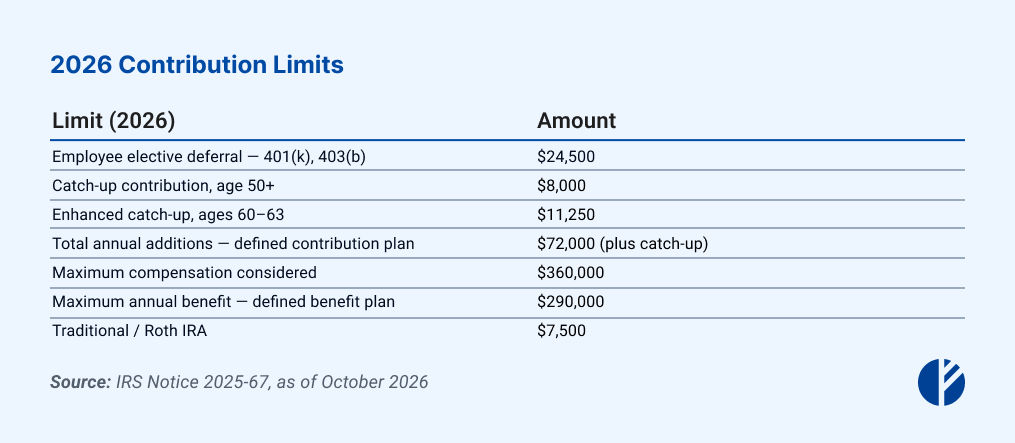
- Mandatory Roth catch-up for higher earners. Beginning in 2026, participants who earned more than $150,000 in FICA wages in the prior year must make any catch-up contributions on a Roth basis. For many owners, that is not a penalty — it is an automatic way to build tax diversification.
Having both pre-tax and Roth money gives you flexibility in retirement to manage your bracket year by year — a planning lever that is hard to create after the fact.
Layer 4: Tax Credits That Offset the Cost
The most common objection we hear from small business owners is cost: plan setup, administration, and employer contributions. Congress has addressed that directly.
Under the SECURE Act and SECURE 2.0, eligible employers with up to 100 employees may claim:
- A startup cost credit of up to $5,000 per year for the first three years, covering up to 100% of eligible plan startup and administration costs for employers with 50 or fewer employees (50% for employers with 51–100).
- An automatic enrollment credit of $500 per year for three years for adding auto-enrollment.
- An employer contribution credit of up to $1,000 per eligible employee per year, phasing down over five years, for businesses with 50 or fewer employees (reduced for 51–100).
Because these are credits rather than deductions, they reduce your tax bill dollar for dollar. For many small employers, the credits cover a large share of the plan's first-year costs.
Note that the credits require at least one non-highly compensated employee to participate — they are not available for owner-only plans.
Choosing the Right Plan
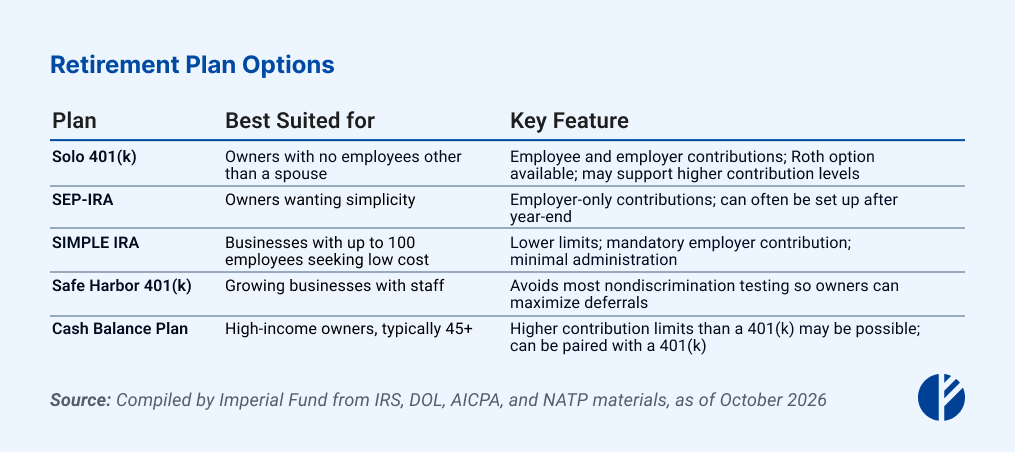
The tax benefits above are only as good as the plan design that captures them. Here's how the main options generally line up:
For owners who are behind on savings or have volatile, high income, combining a 401(k) with a Cash Balance plan can allow total deductible contributions well into six figures in a single year, depending on age, income and employee census.
Common Traps to Avoid
The tax savings are significant, but so are the penalties for getting the details wrong. The issues we see most often include:
- Excess contributions above the annual limits, which must be corrected to avoid additional tax.
- Controlled-group and affiliated-service rules. If you own more than one business, employees of a related company may have to be covered — a frequent surprise for owners with multiple entities.
- Missed filings. A Solo 401(k) generally requires Form 5500-EZ once plan assets exceed $250,000, and late-filing penalties add up quickly.
- Prohibited transactions, such as using plan assets to benefit yourself or family members directly.
- Early withdrawals before age 59½, which generally trigger a 10% additional tax on top of ordinary income tax, unless an exception applies.
The Bottom Line
A retirement plan is not just a line item in your benefits package. It is a deduction today, a compounding engine for decades, a source of potentially tax-free income later and, for many small businesses, a strategy partially funded by federal tax credits.
For owners considering a plan, the question is how its potential value compares with its costs—and which design may best fit your specific situation.
At Imperial Fund Asset Management, we design retirement strategies for business owners and self-employed professionals and coordinate directly with their CPAs so that plan design, contributions and tax filings work together.
If you'd like to see what a plan could mean for your business, we're happy to run the numbers with you.
About the Author
Yuri Nosenko is a Wealth Advisor and Investment Adviser Representative at Imperial Fund Asset Management, where he leads the firm's wealth management practice.
He specializes in tax-efficient retirement planning for business owners and self-employed professionals, including Solo 401(k), SEP-IRA and Cash Balance plans.
DISCLOSURES
This article is provided for general educational purposes only and does not constitute tax, legal or individualized investment advice.
Tax laws are complex and subject to change; please consult a qualified tax professional regarding your specific circumstances.
The hypothetical example is for illustrative purposes only, does not reflect actual investments or client results, and does not account for fees, expenses or changes in tax law.
Past performance is not indicative of future results, and all investments involve risk, including loss of principal.
Contribution limits and tax credit amounts are based on information published by the IRS as of the date of writing.
Imperial Fund Asset Management is a SEC-registered investment adviser.
SEC registration does not imply a certain level of skill or training.
The information provided is for informational purposes only and should not be considered investment advice or a solicitation to buy or sell any securities.
All investments involve risk, including the possible loss of principal. Please review our
full disclaimer for additional information.