When, What, and How: Securitization
History
In 1968, the Government National Mortgage Association (Ginnie Mae) was founded. Its purpose was to ensure certain housing loans remained affordable by acting as an insurer.
Home loans insured by the government, such as ones for veterans and law enforcement, have lower rates than other mortgages because the government guarantee of returns significantly reduces the risk of financial losses for investors.
In 1970, Ginnie Mae pioneered the pooling of such loans and the issuance of the first Mortgage-Backed Securities (MBS).
These securities allowed investors to purchase claims on the cash flows from principal and interest payments on U.S. mortgages.
MBS became popular because it simplified the investment process into the US mortgage market.
Investors gained exposure to pools of high-quality loans that would otherwise take huge resources to source and manage.
Lenders gained new avenues to sell loans and raised capital to fund more loans as a result.
The process to enable this, securitization, transformed mortgage markets. Further innovation followed, including the first non-mortgage securitization.
What is it?
Securitization is the process of pooling assets and converting claims on their cash flows into tradable securities.
These resulting securities are referred to as asset-backed notes, asset-backed bonds or asset-backed obligations.
The underlying assets include, but are not limited to:
- Mortgages
- Credit card receivables
- Auto and equipment leases
- Transfer fees for professional athletes
- Oil & Gas Production
- Music Royalties
How do Securitizations work?
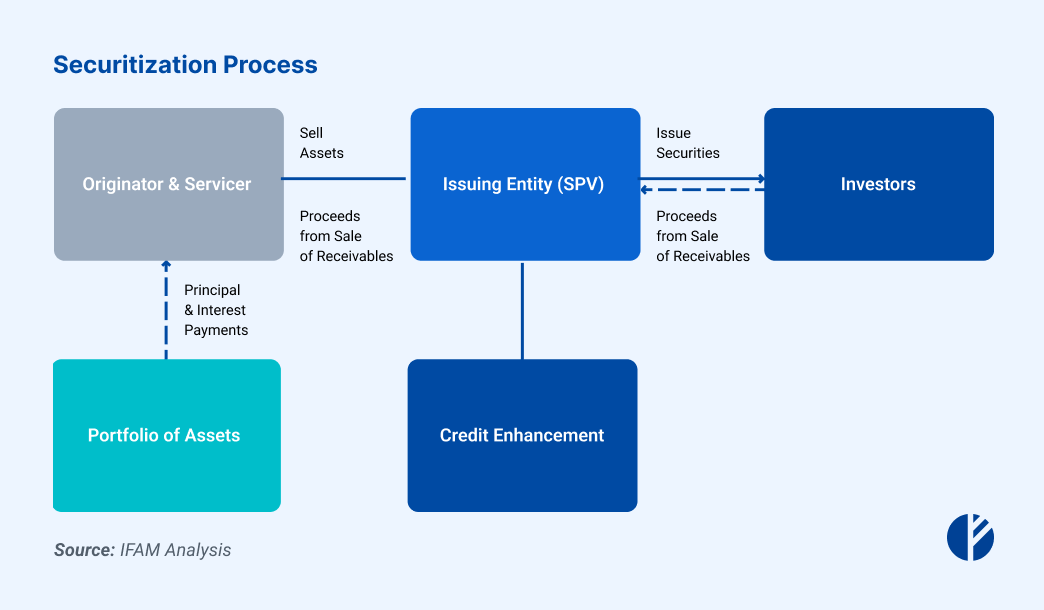
- An asset is originated with future cash flows to come;
- An asset is then sold to a special purpose vehicle (SPV), isolating the asset from originator-associated risk;
- SPV pools the asset with other similar assets;
- SPV issues asset backed securities - legal claims on cash flows generated by the pool of assets;
- Investors pay the SPV for the securities;
- SPV distributes any future cash flows to security-holders.
Securitizations are simultaneously beneficial for issuers, investors and markets.
- Access – Securitizations enable investors to access cash flows without having to purchase, originate or maintain the underlying asset.
- Simplicity – Investors hold simple bonds or notes instead of complex pools of loans.
- Liquidity – Securitizations broaden potential investor bases for assets. This introduces liquidity into markets, enabling greater supply in areas such as mortgage lending.
Securitizations also carry risks:
- Credit Risk – Most securitized products don’t carry guaranteed returns. Returns from them are affected by the performance of the underlying asset.
- Interest Rate Risk – Bond securities typically depreciate in price when interest rates rise, and vice versa.
- Prepayment Risk – For certain securitized products, such as Residential Mortgage-Backed Securities (RMBS), returns are dependent on the interest payments of the underlying loans. If part of the loan is paid down early, then potential returns are lost.
How are risks addressed?
Securitization is a function of structured finance. As such, it is common to see certain structural features in the deals to make them as desirable as possible.
-
Tranching – A pool of securities may be ordered in terms of tranches, ranging from senior, low risk debt to subordinate, high yield debt. Slicing securities into tranches enables specific risk/return profiles to be targeted. The most subordinate debt takes losses first, ensuring a ‘cushion’ for more senior debt holders.
-
Overcollateralization – A security can be underpinned by collateral of a greater value. This provides another cushion for investors in case of unexpected losses.
-
Step-up – Securities may have an automatic ‘step-up’ in place which activates after a certain period. This can help protect against interest rate risk by ensuring investors in a security will experience improved rates of return over time.
Securitized products in the U.S. Fixed Income
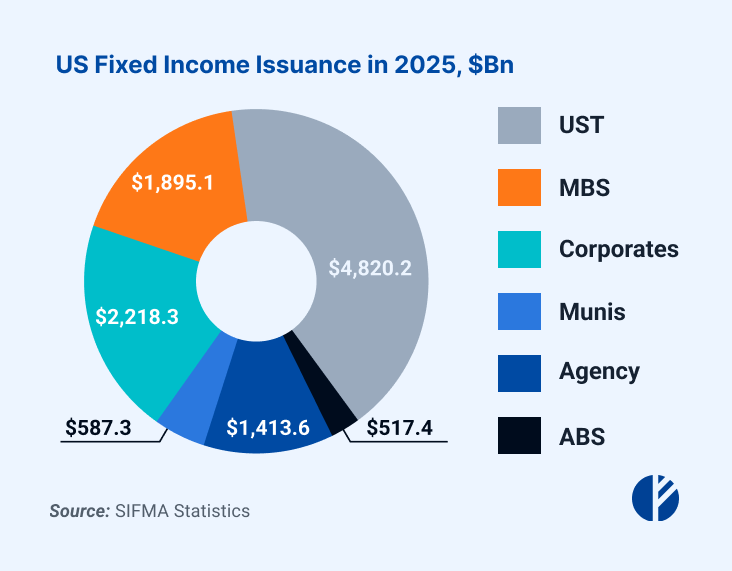
The U.S. outstanding fixed-income market was valued at approximately $48.9 trillion as of Q3 2025.
In 2025, U.S. Treasuries accounted for $4.8 trillion of the $11.4 trillion in US Fixed Income issuance.
Mortgage-Backed securities (MBS) accounted for over $1.8 trillion in issuance last year.
Together, securitized credit (agency and non-agency combined) makes up ~21% of the total fixed-income universe, underscoring its systemic importance.
Alongside Treasuries and corporate bonds, securitized debt is one of the three largest pillars of U.S. fixed income.
U.S. Residential Mortgage-Backed Securities (RMBS)
Market data
The total value of the U.S. housing market is about $47.9 trillion. Of that value, household equity is around $34.5 trillion and mortgage debt (which is part of that) is about $13.9 trillion in Q1 2025 in some metrics.
Homeownership continues to be in high demand. The median sale price for a house sold in the United States was $257,400 in Q1 2007, and was $410,800 in Q2 2025.
Despite this growing demand large banks that traditionally dominated this space are increasingly restrained by government regulations which hinder their investment opportunities.
Concurrently, the United States private credit market grew from $46Bn (2000) to $1.6Tn in 2024.
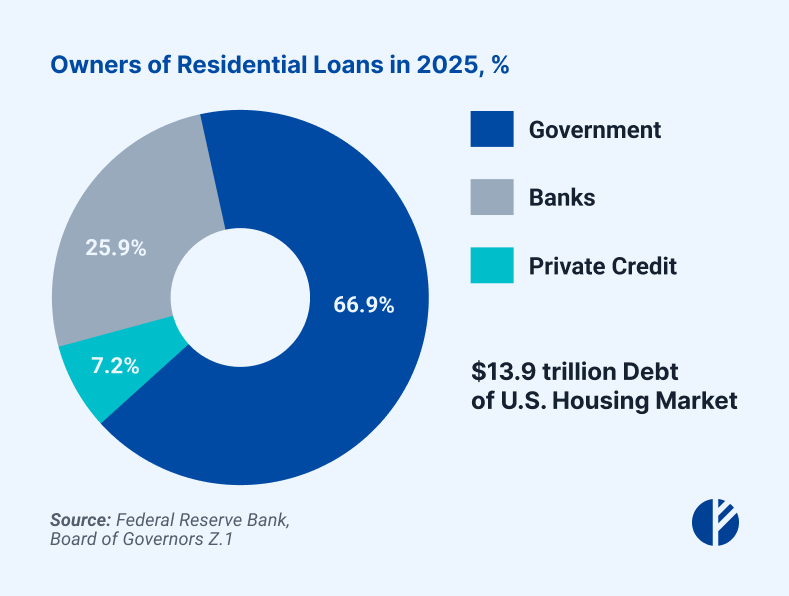
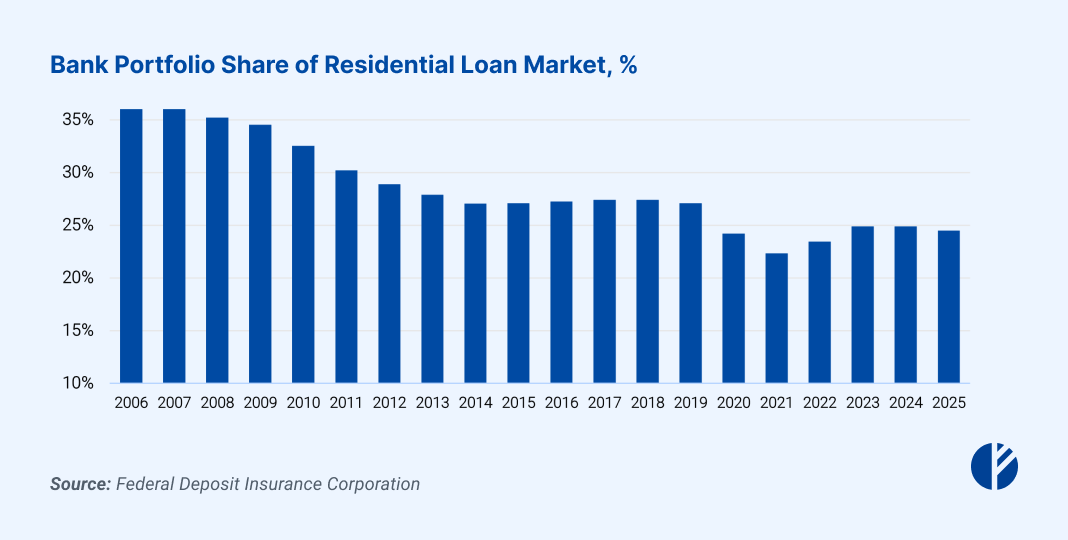
Since the Global Financial Crisis, banks have continued to scale back their mortgage activities, reducing their share of the residential loan market.
This retreat has opened the door for alternative capital providers to serve borrowers who fall outside of agency guidelines.
There also remains a large cohort of underserved yet high-quality borrowers who fall outside traditional agency guidelines.
As banks and GSEs tighten standards, the opportunity for private credit continues to grow, offering solutions for borrowers with strong financial profiles but non-conforming circumstances.
A lower Housing Credit Availability Index (HCAI) reflects these tighter lending standards, highlighting how difficult it has become for many households to access financing through conventional channels.
RMBS
RMBS are fixed-income investments backed by a pool of residential mortgages.
These mortgages are grouped together and sold to investors as securities.
Investors in RMBS receive payments derived from the principal and interest on the underlying mortgages.
This means investors are essentially purchasing a share of future cash flows from thousands of individual home loans.
These instruments fall into two broad categories:
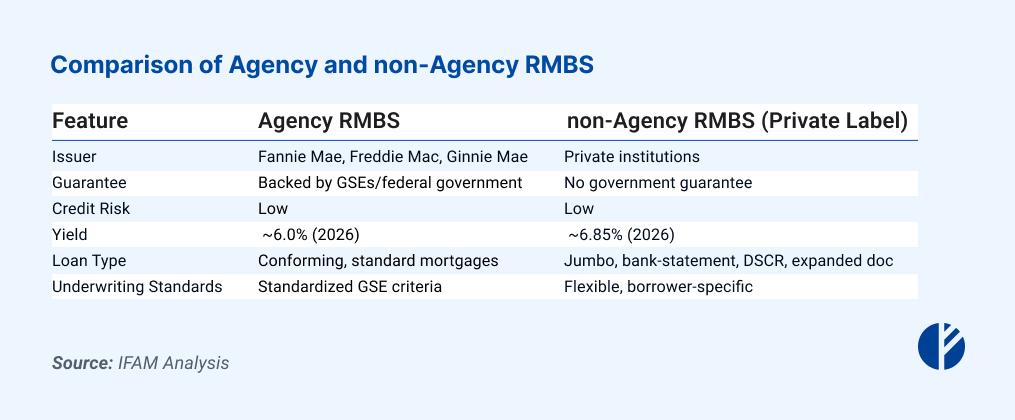
- Agency RMBS: Guaranteed by U.S. government-sponsored enterprises (GSEs) such as Fannie Mae, Freddie Mac, or Ginnie Mae.
- Non-Agency (Private Label) RMBS: Not backed by GSEs and are issued by private institutions.
Origin of non-Agency mortgage market
The non-Agency market emerged in response to regulatory reforms which followed the 2008 financial crisis.
The regulatory aftermath (“RMBS 2.0”) significantly reshaped the lending landscape.
In the aftermath of the crisis, Congress passed the Dodd-Frank Wall Street Reform and Consumer Protection Act in 2010.
Among its provisions was the creation of the Qualified Mortgage (QM) framework and Ability-to-Repay (ATR) rules—aimed at ensuring responsible underwriting and preventing the types of risky loans that fueled the collapse.
New rules frequently excluded creditworthy borrowers who didn’t fit the “traditional” profile—for example, self-employed individuals, real estate investors, or home buyers who might not have a W-2.
To assist these home purchasers, lenders started originating non-Agency loans: mortgage products that fall outside of GSE provisions but still require responsible underwriting and ability-to-repay verification.
Over time, this niche has matured into an institutionalized market offering access to loans for borrowers, and attractive risk-adjusted returns for investors.
Comparison of Agency and non-Agency RMBS
Agency loans refer to loans that are insured by government sponsored enterprises such as Fannie Mae, Freddie Mac, and Ginnie Mae.
While this provides significant support to the mortgage market, there are strict guidelines for a mortgage loan to qualify as agency.
Guidelines cover variables such as loan size and property use.
Who is a non-Agency borrower?
Non-Agency borrowers are individuals or investors who fall outside the Consumer Financial Protection Bureau’s (CFPB) Qualified Mortgage (QM) framework and therefore do not qualify for traditional agency programs, despite often having strong financial profiles.
They include:
- Self-employed individuals who verify income through bank statements
- Real estate investors
- Foreign nationals
- Borrowers with recent credit events (e.g., bankruptcy, foreclosure)
- Jumbo loan seekers
- Athletes, entertainers, or professionals with irregular income
- Individuals with irregular or seasonal income
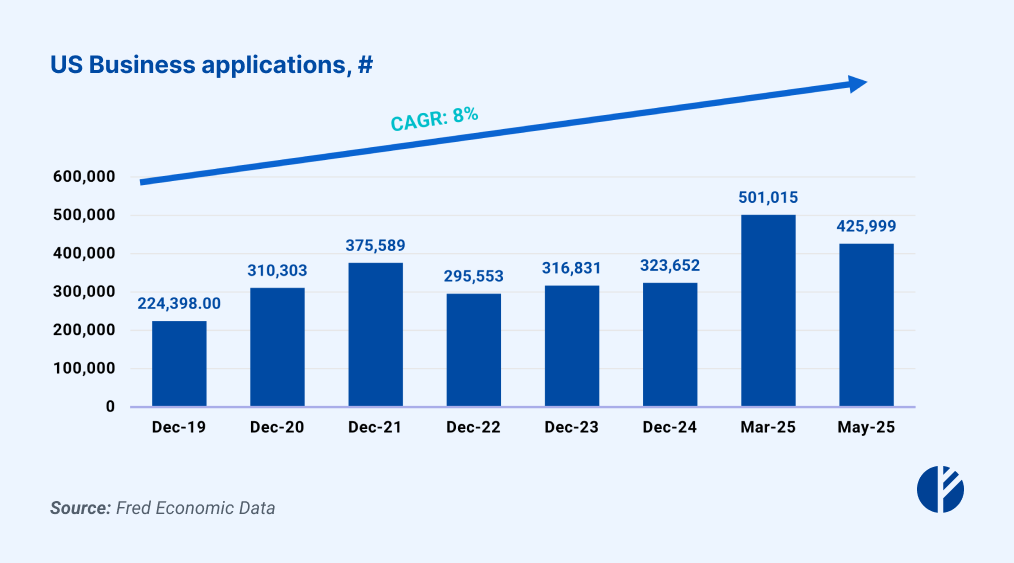
This segment is large and growing: the number of self-employed individuals has reached over 16 million as of February 2024, up from 9.6% of the labor force just three years earlier, supported by strong growth in new business applications.
These trends highlight the expanding base of creditworthy but underserved borrowers that non-Agency mortgages are designed to serve.
Non-Agency loans allow lenders to use alternative documentation, flexible income verification, and custom credit standards, while still performing rigorous ability-to-repay (ATR) evaluations.
What types of income verification are in non-Agency RMBS?
Mortgages are grouped by the supporting documents (‘doc types’) that the loan is underwritten to:
-
Asset Depletion – Loans can be underwritten to liquid assets such as investment accounts/CDs.
-
Bank Statement – Historical bank statements can serve as proof of possessing adequate assets to adequately maintain a loan.
-
DSCR – A ‘Debt Service Coverage Ratio’ mortgage is one commonly used by investors who intend to rent the mortgaged property out.
The loan is underwritten according to rental cash flow projections. If the rental income is higher than the servicing cost, the DSCR is greater than one (and vice versa).
-
Full Doc – These loans are underwritten to the historical income statements of a borrower.
-
P&L – Self-employed individuals provide their business’s Profit & Loss statements to qualify.
Investors in Non-Agency Residential Mortgage-Backed Securities (RMBS)
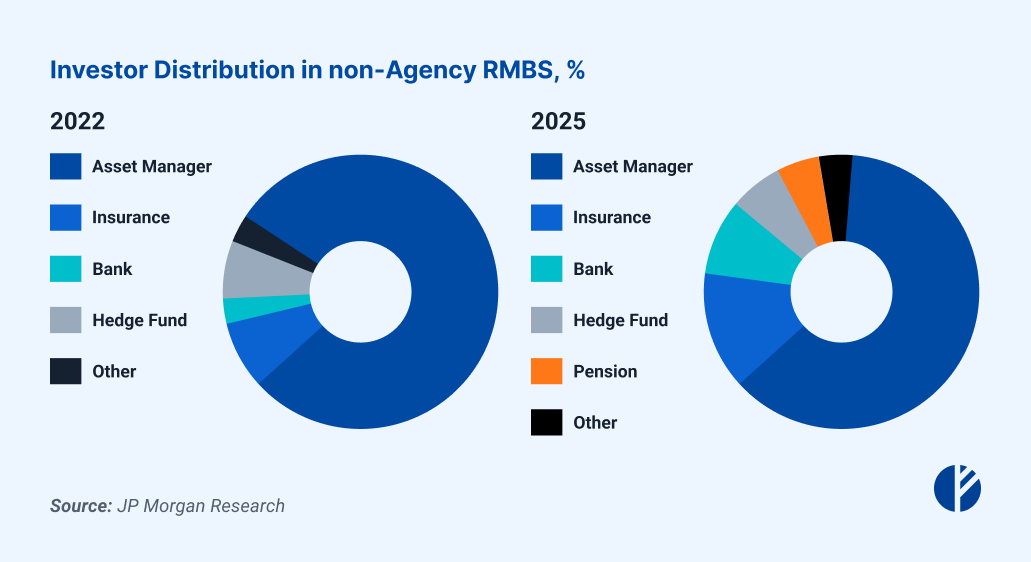
The non-QM market has grown from $9Bn in issuance (2018) to $80Bn in 2025. A growing number of institutional investors have entered the non-Agency space, attracted by enhanced yield potential and risk-adjusted returns.
Role of non-Agency Mortgage in Insurance portfolio
Non-agency mortgage assets have become an important component of insurance company portfolios, offering a blend of regulatory efficiency, safety, and enhanced returns.
Under the Dodd-Frank Ability-to-Repay (ATR) and Qualified Mortgage (QM) rules, post-crisis non-agency loans are generally subject to enhanced underwriting standards,
which may contribute to improved credit quality characteristics while offering spreads that are typically higher than those of agency MBS or similarly rated corporate bonds.
For insurers, these instruments also carry favorable NAIC risk-based capital (RBC) treatment and can serve as eligible collateral for Federal Home Loan Bank (FHLB) advances, providing valuable liquidity flexibility.
Over the five-year period ending in 2024, agency RMBS represented a declining share of U.S. insurers' total RMBS holdings, while private-label RMBS gained ground steadily.
Despite agency RMBS maintaining its position as the dominant component throughout this period, its share dipped below the 70% threshold for the first time in 2024, closing the year at 68% — with private-label RMBS accounting for the remaining 32%.
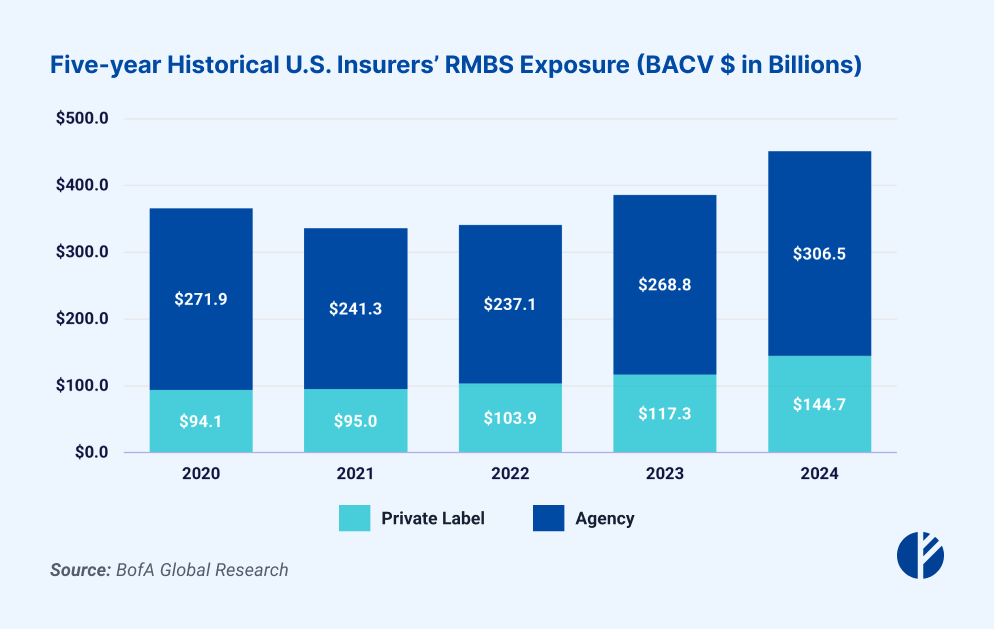
This gradual shift likely reflects the comparatively lower yields offered by agency bonds, which have made them less compelling relative to similarly rated private-label RMBS and other structured credit instruments,
prompting insurers to incrementally reallocate toward higher-yielding alternatives.
In addition, insurers had pledged about $321 billion in collateral to the FHLB system and held $160.6 billion in outstanding FHLB advances at the end of 2024.
In recent years, many insurers have also become direct investors in whole non-agency loans, drawn by their ability to deliver incremental yield while still aligning with liability structures and regulatory requirements.
Why do investors participate in non-Agency RMBS?
Firms invest in non-Agency RMBS to gain exposure to a growing sector of US Mortgage Debt.
Bond-buyers receive coupon payments tied to the successful pay down of principal and interest balances on the underlying mortgage pool.
Interest rates on non-Agency mortgages are typically ~1% higher than that on comparable conventional mortgages.
The return of a bond is typically expressed in terms of the premium it yields relative to the comparable-duration treasury security.
A BBB Non-Agency bond with a yield that is 2.5% higher than the comparable treasury would be referred to as having a 250bp spread.
The most senior, lowest-yield, investment-grade bonds in an RMBS stack have the “tightest” spreads, and the most subordinate, highest-yield credit bonds have the “widest” spreads.
References
DISCLOSURES
This material is provided for informational and educational purposes only and does not constitute investment, legal, tax, or accounting advice, or a recommendation to buy or sell any security or investment product.
Investments in mortgage-backed and asset-backed securities involve risks, including interest rate risk, credit risk, liquidity risk, prepayment risk, extension risk, and possible loss of principal.
Past performance is not indicative of future results, and there can be no assurance that any investment strategy will achieve its objectives.
Certain information contained herein has been obtained from third-party sources believed to be reliable; however, Imperial Fund Asset Management LLC does not guarantee its accuracy or completeness.
Any forward-looking statements or market observations are subject to change without notice and may not reflect future market conditions.